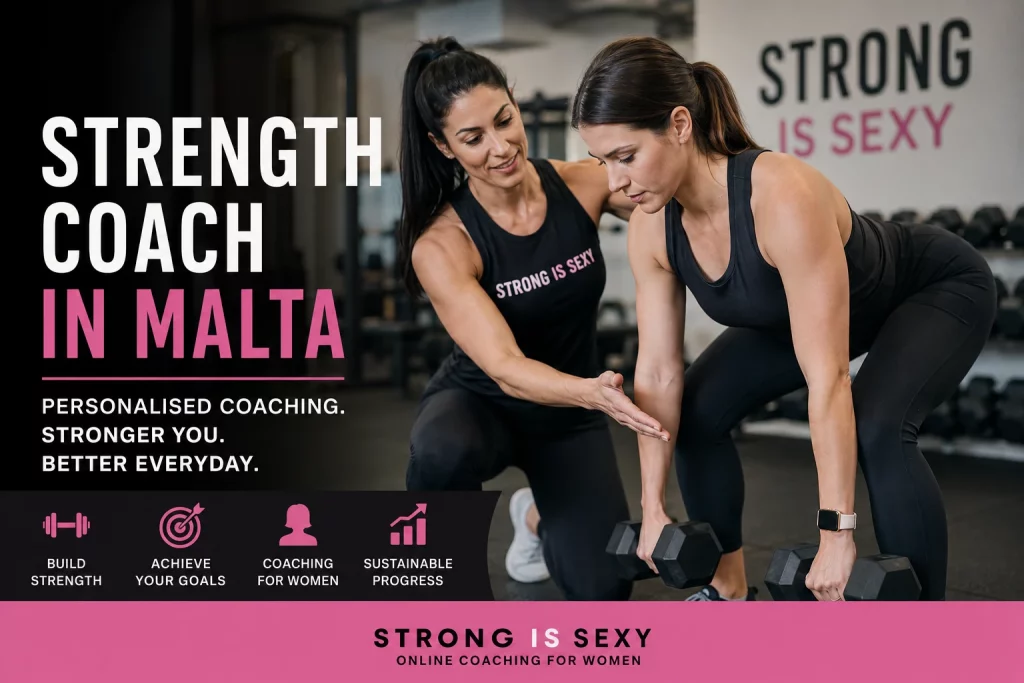
Searching for a strength coach in Malta usually starts with a simple goal: you want to feel stronger, become more confident in the gym, improve your body composition or finally make progress that feels consistent.
But effective strength coaching is about much more than being given a list of exercises.
A good coach helps you understand what to train, why you are training it, how hard to work, and when your programme needs to progress. Instead of jumping between random workouts, social media challenges or routines designed for somebody else, you follow a plan built around your starting point, goals and lifestyle.
For many women, particularly from their mid-thirties onwards, that structure can completely change the way training feels.
You do not necessarily need to spend more time exercising. You need the time you already invest to have more purpose.
If you are still learning the fundamentals and benefits of resistance exercise, start with our guide to women’s strength training in Malta. This guide focuses on something different: what a strength coach actually does, how personalised programming works and how to choose the right coaching approach for you.
What Does a Strength Coach in Malta Actually Do?
A strength coach does far more than count repetitions or tell you which machine to use next.
The real job is to create a structured path between where you are now and where you want to be.
That begins with understanding you.
Your coach may consider your:
1. Current strength and fitness level
2. Previous training experience
3. Goals and priorities
4. Weekly schedule
5. Available equipment
6. Exercise confidence
7. Movement limitations
8. Recovery and stress levels
9. Nutrition and lifestyle habits
11. Previous injuries or areas requiring additional care
From there, your training can be built around your circumstances rather than forcing you into a generic programme.
A personalised strength coaching approach may include exercise selection, weekly programming, technique guidance, progress tracking, progressive overload, recovery management and regular adjustments as your ability improves.
The goal is not simply to make every session difficult.
It is to make every session useful.
You should understand what you are working towards and be able to recognise progress even when that progress is not immediately visible in the mirror.
Strength Coach vs Personal Trainer: What Is the Difference?
The terms strength coach and personal trainer often overlap, and many professionals can provide elements of both.
The main difference is usually the emphasis of the coaching.
A general personal trainer may support a wide range of goals, including general fitness, cardio, mobility, weight management and introductory resistance exercise.
Strength coaching tends to place greater emphasis on structured resistance training, technique, measurable progression and long-term physical development.
Instead of constantly changing exercises simply to make workouts feel new, a strength-focused programme often keeps key movements consistent long enough for you to become better at them.
For example, your coach may track:
1. The weight you lift
2. Repetitions completed
3. Exercise technique
3. Range of motion
4. Training volume
5. Recovery
6. Movement confidence
7. Performance over time
These measurements help remove guesswork.
They can also show that you are progressing even during periods when physical changes happen more slowly.
If you are comparing broader coaching options rather than specifically strength-focused programming, our guide to finding a personal trainer for women in Malta explains that approach in more detail.
Who Can Benefit From Working With a Strength Coach?
You do not need to be an athlete or an experienced lifter to work with a strength coach in Malta.
In fact, beginners can often benefit most because they have the opportunity to build good habits from the beginning.
You Feel Lost in the Gym
Walking into a gym without a plan can become frustrating very quickly.
You use whichever machine is available, repeat exercises you remember from previous workouts, or copy something you saw online without knowing whether it actually fits your goals.
A structured programme removes much of that uncertainty.
You arrive knowing what you are doing and why you are doing it.
You Have Been Training, but Progress Has Stalled
Training more is not always the answer to a plateau.
Sometimes you need to adjust training volume, exercise selection, intensity, recovery or technique rather than simply adding another workout.
A coach can look at the entire programme and decide what actually needs changing.
You Want to Learn How to Lift Properly
Building strength requires more than moving a weight from one position to another.
Learning good technique helps you train with greater control and confidence.
A strength coach can guide you through fundamental patterns such as squatting, hinging, pushing, pulling, carrying and core stability while selecting variations appropriate for your ability.
You Struggle With Consistency
Consistency becomes easier when you are not constantly deciding what to do.
Your programme gives you direction, while coaching provides accountability and a process for adapting the plan when life becomes busy.
That can be far more sustainable than relying on motivation alone.
Why Strength Coaching Can Be Particularly Valuable After 35
Many women enter their mid-thirties or forties after years of being told that fitness is mainly about burning calories, losing weight, or making their body smaller.
Strength training offers a different perspective.
Instead of only asking what the scales say, you begin asking:
Can I lift more than I could three months ago?
Can I squat with better control?
Can I complete a push-up?
Do I feel more confident using weights?
Can I train consistently without feeling completely exhausted?
These are meaningful forms of progress.
As women move through their late thirties, forties and beyond, recovery, sleep, stress and hormonal changes may also affect how training feels from week to week.
That does not mean women suddenly need completely different exercises.
It means training needs to be intelligent enough to account for the individual performing it.
When perimenopause or menopause becomes part of the picture, more specialised support may also be useful. Our guide to menopause coaching in Malta explores this area in greater detail.
A good strength coach knows when to progress, when to maintain, and when adjusting the programme is more productive than simply pushing harder.
What Does Personalised Strength Programming Actually Look Like?
A personalised programme does not need to be complicated.
In fact, good strength programmes are often much simpler than the random workouts people collect from social media.
Your programme may be built around several key movement patterns.
Squat-Based Movements
These could include goblet squats, leg presses, split squats or step-ups.
Hip-Hinge Movements
Romanian deadlifts, deadlift variations, hip thrusts and glute bridges can all fall into this category.
Upper-Body Pushing
Depending on your ability and available equipment, this could include push-ups, chest presses or overhead pressing variations.
Upper-Body Pulling
Rows, lat pulldowns and assisted pull-ups may be used to build back and upper-body strength.
Core and Stability Work
Core training is not simply about doing hundreds of abdominal repetitions.
It can include movements designed to improve trunk control, balance, stability and the ability to transfer strength effectively through the body.
Your coach then decides which variations, sets, repetitions and resistance levels are appropriate for you.
As you improve, the programme evolves.
That progression is one of the biggest differences between following random workouts and following an actual coaching strategy.
Progressive Overload Without Chasing Heavier Weights Every Week
Progressive overload is one of the foundations of strength development, but it is often misunderstood.
Progress does not mean setting a personal record every time you enter the gym.
You might progress by:
1. Adding a small amount of resistance
2. Completing an additional repetition
3. Improving your technique
4. Increasing your range of motion
5. Performing the same weight with better control
6. Adding a set when appropriate
7. Improving stability
8. Reducing assistance on an exercise
These changes may seem small individually, but they accumulate over weeks and months.
A strength coach helps decide which type of progression makes sense at each stage rather than simply telling you to lift heavier every session.
Effective Strength Training Should Not Destroy You
One of the most damaging fitness misconceptions is that a workout is only effective if you leave completely exhausted.
Hard sessions can have their place.
But exhaustion itself is not the goal.
You are training to create an adaptation that your body can recover from and build upon.
If every session leaves you unable to recover before the next one, the programme becomes harder to maintain and consistency can suffer.
Instead of asking:
“Was that workout hard enough?”
A better question is:
“Did that workout move me closer to my goal?”
That shift is important.
Strength coaching turns individual workouts into parts of a larger strategy.
Online Strength Coaching in Malta: Can It Really Work?
If you live in Malta, working with a coach does not necessarily mean somebody has to stand beside you during every gym session.
For many women, online strength coaching provides the right combination of professional guidance and flexibility.
Through structured online strength coaching for women, your programme can be built around your goals, schedule and available equipment while still providing accountability and regular adjustments.
Depending on the coaching structure, support may include:
1. Personalised training programming
2. Exercise demonstrations
3. Progress tracking
4. Regular check-ins
5. Programme adjustments
6. Accountability
7. Nutrition guidance where appropriate
8. Messaging support
9. Support around travel or busy periods
You then complete your sessions at the gym, at home or wherever your programme is designed to be performed.
For many women, this approach also builds independence.
The goal is not to make you permanently dependent on somebody standing beside you.
It is to help you understand your training well enough to become confident in what you are doing.
How Often Should Women Strength Train?
There is no perfect training frequency for everyone.
The right number of sessions depends on your current ability, goals, recovery and the amount of time you can realistically dedicate to training.
For many women, two to four well-structured strength sessions per week can provide a practical starting framework.
A beginner might progress extremely well with two or three focused sessions.
Someone with more experience may require additional volume.
But more training is not automatically better.
Three sessions that you consistently complete are more valuable than planning five sessions every week and regularly missing half of them.
A good strength coach in Malta should build your training around a schedule you can realistically sustain.
Can Strength Coaching Support Fat Loss?
Absolutely, but strength training and fat loss should not be treated as exactly the same goal.
If reducing body fat is important to you, strength training can form part of a broader strategy involving nutrition, daily activity, recovery and, where appropriate, cardio.
Resistance training gives you a performance goal beyond simply burning calories.
Rather than spending every workout trying to burn as much energy as possible, you can focus on becoming stronger while your overall nutrition and lifestyle strategy supports body-composition goals.
If fat reduction is currently your primary objective, our complete guide to working with a Fat Loss Coach in Malta explains the nutrition, training and lifestyle side of that process in much more detail.
How to Choose the Right Strength Coach in Malta
Choosing a coach should involve more than scrolling through transformation photos or watching difficult-looking workouts on social media.
Look at how the coach actually works.
Personalisation
Your programme should reflect your experience, goals, schedule and available equipment.
A template with your name added to the top is not genuinely personalised coaching.
A Clear Progression Strategy
Ask how progress is measured.
There should be an explanation for why exercises, repetitions or training variables change.
Communication
Coaching works best when communication goes both ways.
You should feel comfortable explaining when an exercise feels wrong, when your schedule changes or when something in the programme is becoming difficult to maintain.
Experience Coaching Women
If you are a woman in your late thirties, forties, fifties or beyond, choosing somebody who understands the realities of training women through different stages of life can be particularly valuable.
A Sustainable Philosophy
Be cautious of programmes built entirely around restriction, punishment or rapid transformations.
Long-term strength is developed through manageable progress repeated consistently.
Questions to Ask Before Hiring a Strength Coach
Before committing to coaching, consider asking:
- How will my training programme be personalised?
- How will you measure my progress?
- How often will my programme be reviewed?
- What happens if an exercise causes discomfort?
- Can my programme work with the equipment available to me?
- What happens when I travel or have an unusually busy week?
- How regularly will we check in?
- Is nutrition guidance included?
- How do you adapt training for beginners?
- What support is available between check-ins?
The answers should give you a much clearer idea of whether the coaching relationship is right for you.
What Kind of Progress Should You Expect?
Progress does not always begin with dramatic visual changes.
Some of the earliest improvements may be:
- Better technique
- Greater confidence in the gym
- More consistent workouts
- Increased resistance on key exercises
- Better movement control
- Improved understanding of your programme
- Less uncertainty about what to do
- A healthier relationship with training
Over time, those smaller wins form the foundation for larger changes.
If you want to see how personalised coaching has worked for other women, explore the Strong Is Sexy client transformations.
Frequently Asked Questions About Strength Coaching in Malta
Is a strength coach in Malta only for experienced gym users?
No. Beginners can benefit enormously from strength coaching because the programme can begin at their current level. Coaching provides structure, technique guidance and gradual progression instead of expecting you to already know your way around the gym.
Can I work with a strength coach online while living in Malta?
Yes. Online coaching allows women in Malta to receive personalised programming, progress tracking, check-ins and ongoing support while completing workouts at their preferred gym or home training environment.
What is the difference between a strength coach and a personal trainer?
There can be significant overlap. Strength coaching generally places greater emphasis on structured resistance training, technique and measurable progression, while personal training may cover a broader range of general fitness goals.
Do I need to lift very heavy weights?
No. The resistance should match your current ability. Over time, your programme can gradually become more challenging as your strength and technique improve.
Is strength coaching suitable for women over 40?
Yes. Strength training can be adapted to different experience levels and stages of life. Your programme should reflect your current ability, recovery, lifestyle and individual goals rather than being based on age alone.
Can a beginner start strength coaching?
Absolutely. You do not need to become fit before working with a coach. A well-designed beginner programme should teach you the fundamentals first and progress as your confidence and ability develop.
Can strength coaching help with fat loss?
Strength coaching can support a broader body-composition strategy, but nutrition, everyday activity, recovery and overall lifestyle also matter. If fat loss is the main priority, those areas should be addressed alongside resistance training.
How many strength sessions do I need each week?
There is no universal number. Many women can make meaningful progress with two to four structured sessions per week, depending on their experience, goals, recovery and schedule.
Ready to Become Stronger With a Plan Built Around You?
Finding the right strength coach in Malta is not about finding someone who can make every workout harder.
It is about finding someone who can make your training smarter.
You need a programme you understand, progress you can measure, and support that adapts when your circumstances change.
At Strong Is Sexy, coaching focuses on personalised strength, nutrition and lifestyle support for women who want to feel stronger, more confident and more capable without relying on generic programmes or unsustainable extremes.
Whether you are returning to exercise, struggling to progress or simply tired of guessing what you should be doing in the gym, the right plan can give your training direction again.
If you are ready to stop jumping between random workouts and start following a programme designed around your body, goals and lifestyle, explore our personalised online coaching programme and take the next step towards becoming genuinely stronger.