Building muscle after 40 as a woman is absolutely achievable, and in many cases it becomes even more important than it was in your twenties or thirties. While hormonal changes during perimenopause and menopause make muscle building slightly more nuanced, the process still follows the same core principles that have always driven muscle growth. Consistent resistance training, adequate protein intake, sufficient recovery, and progressive overload remain the foundation, though the way you apply them often needs to shift as your hormones and lifestyle change.
Many women in this age group worry that their best years for building strength and muscle are behind them. That belief simply isn’t supported by research or real-world results. Women in their forties, fifties, and sixties regularly build meaningful muscle mass when they train and eat appropriately, and doing so brings benefits that extend far beyond appearance, including stronger bones, better metabolic health, and greater functional independence later in life.
Why Muscle Building Changes After 40
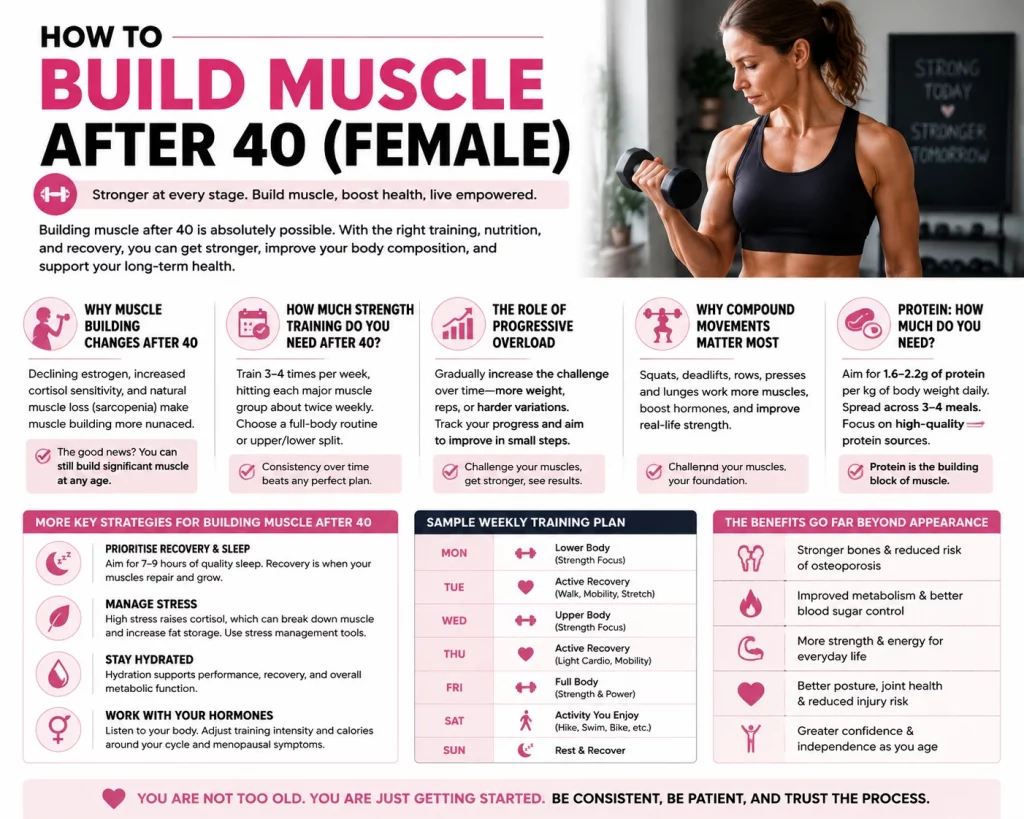
The primary reason muscle building requires a slightly different approach after 40 comes down to hormones. Declining oestrogen during perimenopause and menopause affects muscle protein synthesis, meaning the body becomes somewhat less efficient at using dietary protein to repair and build muscle tissue. Oestrogen also plays a protective role against muscle loss, so as levels decline, the natural rate of age-related muscle loss, known as sarcopenia, tends to accelerate if nothing is done to counteract it.
Cortisol sensitivity also increases during this life stage, meaning chronic stress and inadequate recovery can interfere with muscle building more noticeably than they did in earlier decades. This doesn’t mean muscle building becomes impossible. It simply means training, nutrition, and recovery all need to work together more deliberately than they might have needed to in your twenties. If you’re navigating a wider range of symptoms alongside these training changes, our dedicated menopause support page covers how coaching adapts specifically to this stage of life.
How Much Strength Training Do You Need After 40
Most women see excellent results training with resistance three to four times per week, allowing each major muscle group to be trained roughly twice weekly. This frequency provides enough stimulus to drive muscle growth while still allowing adequate recovery between sessions, which becomes increasingly important as recovery capacity shifts with hormonal changes.
Full body sessions or an upper body and lower body split both work well for this age group, and the right structure often depends more on personal preference and schedule than on any strict rule. What matters most is consistency over time, since muscle building is a gradual process that responds to sustained effort across months rather than any single workout. A personalised training programme built around your schedule and recovery capacity tends to make this consistency far easier to sustain than following a generic template.
The Role of Progressive Overload
Progressive overload simply means gradually increasing the demand placed on your muscles over time, whether through heavier weights, additional repetitions, or more challenging variations of an exercise. This principle remains just as essential after 40 as it was earlier in life, and in many ways becomes even more important, since the body requires a clear and consistent signal to prioritise building and maintaining muscle tissue rather than losing it.
Many women in this age group unintentionally plateau because they settle into a comfortable routine without continuing to challenge their muscles. Tracking your training, whether through a simple notebook or an app, and aiming to improve in small increments over time makes an enormous difference to long-term results.
Why Compound Movements Matter Most
Compound exercises, which work multiple muscle groups simultaneously, tend to deliver the greatest return on investment for women building muscle after 40. Movements such as squats, deadlifts, rows, presses, and lunges recruit far more muscle tissue than isolation exercises, stimulate a stronger hormonal response, and translate directly into functional strength for everyday life.
This doesn’t mean isolation exercises have no place in a well-rounded programme. Targeted work for areas like the shoulders, arms, or glutes can absolutely complement a compound-focused routine. The key is ensuring compound movements form the backbone of your training, with isolation work layered in to address specific goals or imbalances.
How Much Protein Do Women Over 40 Need to Build Muscle
Protein needs typically increase for women over 40, largely because the body becomes somewhat less efficient at using protein for muscle repair and synthesis during this life stage. Many nutrition professionals recommend aiming for roughly 1.6 to 2.2 grams of protein per kilogram of body weight daily for women actively trying to build or maintain muscle after 40, though individual needs vary based on activity level, training intensity, and overall goals.
Spreading protein intake across three or four meals throughout the day, rather than concentrating it into one large meal, appears to support muscle protein synthesis more effectively. Prioritising complete protein sources such as eggs, dairy, poultry, fish, and legumes, alongside consistent post-workout intake, gives your body the raw materials it needs to actually use the stimulus provided by your training. If getting enough protein throughout a busy day feels difficult, our post on eating on-the-go protein offers practical strategies for maintaining consistent intake even with a demanding schedule, and our nutrition coaching service can help you build a fully personalised approach around your specific protein and calorie needs.
Why Recovery Becomes More Important After 40
Recovery plays an increasingly significant role in muscle building as women move through their forties and beyond. Sleep quality often declines during perimenopause due to night sweats and hormonal fluctuations, yet sleep remains one of the most critical periods for muscle repair and growth hormone release. Prioritising consistent, quality sleep is just as important to your results as the training itself.
Managing stress also becomes more relevant, since elevated cortisol can interfere with recovery and even promote fat storage in ways that counteract the benefits of your training. Building in adequate rest days, avoiding excessive training volume, and paying attention to signs of overtraining, such as persistent fatigue or declining performance, all support better long-term muscle-building outcomes.
Should Women Over 40 Train Differently Than Younger Women
The fundamental principles of muscle building do not change dramatically with age, but the practical application often does. Warm-ups tend to become more important as joint mobility and tissue elasticity naturally shift over time. Recovery between sessions may need to be slightly longer, and paying closer attention to technique becomes increasingly valuable in preventing injury while still training with sufficient intensity to drive results.
Many women over 40 also benefit from incorporating a slightly wider variety of rep ranges rather than training exclusively in one narrow zone. Combining heavier, lower-repetition work with moderate repetition ranges appears to support both strength and muscle growth effectively, while also reducing the repetitive strain that can accumulate from training the same way session after session.
Common Mistakes That Slow Muscle Building After 40
One of the most common mistakes women make is under-eating protein, often as a holdover from earlier decades spent prioritising calorie restriction over muscle preservation. Another frequent issue is relying too heavily on cardio at the expense of resistance training, which does little to build or preserve the muscle tissue that becomes increasingly valuable with age. Training with insufficient intensity, avoiding heavier weights out of fear of injury or “bulking up,” also commonly limits progress, despite the fact that building visible muscle as a woman requires significant and deliberate effort rather than happening accidentally.
Underestimating the importance of consistency is another common pitfall. Muscle building is a slow, cumulative process, and expecting dramatic changes within a few weeks often leads to frustration and premature programme changes that interrupt the very progress a woman is trying to make.
How Long Does It Take to Build Muscle After 40
Most women begin noticing improvements in strength within the first two to four weeks of consistent training, largely driven by neuromuscular adaptations rather than significant new muscle tissue. Visible changes in muscle definition and size typically become noticeable between eight and twelve weeks, with more substantial transformations often taking three to six months of consistent, progressive training paired with adequate nutrition and recovery.
Patience remains essential throughout this process. Hormonal changes during this life stage can make progress feel slower or less linear than it might have felt in earlier decades, but consistent effort over months and years produces meaningful and lasting results.
Can Hormone Changes During Menopause Prevent Muscle Growth
Hormonal changes during perimenopause and menopause make muscle building somewhat more challenging, but they do not prevent it. Research consistently shows that women in midlife and beyond can build and maintain significant muscle mass through appropriate resistance training and nutrition, even amid declining oestrogen levels. The key difference is that results may require slightly more deliberate attention to training intensity, protein intake, and recovery than they did in earlier years, rather than the process being fundamentally out of reach. Hunger and appetite changes often accompany this stage too, and our guide on smart snacking and hunger awareness during menopause can help you manage cravings without derailing your protein and calorie targets.
What a Sample Week of Training Might Look Like
A woman over 40 aiming to build muscle might structure her week around four resistance training sessions, each focused on different movement patterns to ensure balanced development while allowing adequate recovery. A lower body-focused session emphasising squats and hip hinge movements might be followed a day or two later by an upper body session centred on pressing and pulling exercises. A full body session incorporating compound lifts across the entire body often rounds out the week effectively, with the remaining days reserved for lighter activity, mobility work, or complete rest depending on how the body is recovering.
The specific split matters far less than the underlying consistency and progressive challenge applied across sessions. Some women prefer training the same muscle groups more frequently with lighter loads, while others respond better to less frequent sessions at higher intensity. Paying attention to how your body responds and adjusting accordingly tends to produce better long-term results than rigidly following any single programme structure without room for individual variation. It also helps to remember that the number on the scale rarely reflects muscle gain accurately in the short term, since water retention and other factors can mask real progress, a topic covered in more depth in our post on why the scale fluctuates.
The Connection Between Muscle Building and Bone Health
Building muscle after 40 offers benefits that extend well beyond aesthetics or strength alone. Resistance training places mechanical stress on bones in a way that stimulates bone density maintenance and, in some cases, improvement, which becomes increasingly important as the risk of osteoporosis rises during and after menopause. The same compound movements that build muscle, including squats, deadlifts, and loaded carries, simultaneously support skeletal health in a way that few other activities can replicate.
This connection between resistance training and bone density is one of the most compelling reasons for women in this age group to prioritise strength training specifically, rather than relying solely on cardiovascular exercise for overall health. The muscle you build today becomes a form of long-term insurance for mobility, independence, and physical resilience well into later decades of life.
Why Consistency Matters More Than Perfection
Women who succeed in building muscle after 40 tend to share one trait above all else, which is consistency sustained over months rather than perfect adherence sustained over weeks. Missing an occasional session, adjusting a programme around travel, or having a lower energy week due to hormonal fluctuations will not meaningfully derail progress, provided the overall pattern of training and eating remains steady over time. Chasing an unrealistic standard of perfection often leads to burnout or abandoning a programme entirely after a single setback, whereas a flexible, sustainable approach tends to produce far better long-term outcomes.
Reframing muscle building as a long-term lifestyle practice, rather than a short-term project with a fixed end date, tends to shift both mindset and results. The women who look back after a year or two with genuine strength and muscle gains are rarely the ones who trained perfectly every single week. They are the ones who kept showing up, adjusted when needed, and trusted the process even when progress felt slow.
Frequently Asked Questions
What is the best way to build muscle after 40 as a woman?
The most effective approach combines consistent resistance training three to four times weekly, sufficient protein intake spread throughout the day, adequate sleep and recovery, and a gradual, progressive increase in training demands over time.
Is it harder for women to build muscle after 40?
It can be somewhat more challenging due to declining oestrogen and its effects on muscle protein synthesis and recovery, though with the right training and nutrition approach, meaningful muscle growth remains entirely achievable.
How many days a week should a woman over 40 lift weights to build muscle?
Most women see strong results training three to four days weekly, allowing each major muscle group to be worked roughly twice per week with adequate recovery between sessions.
Do women over 40 need more protein to build muscle?
Yes, protein needs typically increase during this life stage, with many women benefiting from roughly 1.6 to 2.2 grams per kilogram of body weight daily to support muscle repair and growth effectively.
Where This Leaves You
Building muscle after 40 as a woman requires understanding how hormonal changes influence recovery, protein needs, and training response, then adjusting your approach accordingly rather than abandoning the effort altogether. With consistent resistance training centred around compound movements, adequate protein intake, prioritised recovery, and realistic expectations around timeline, women well into midlife and beyond continue to build genuine strength and muscle, along with the metabolic and functional benefits that come with it. Structured accountability tends to accelerate this process considerably, and our post on the benefits of online coaching for women explains why guided support often outperforms going it alone.
If you would like a training and nutrition approach built specifically around your hormones, lifestyle, and goals, book a free discovery call and let us create a plan designed for exactly where your body is right now.