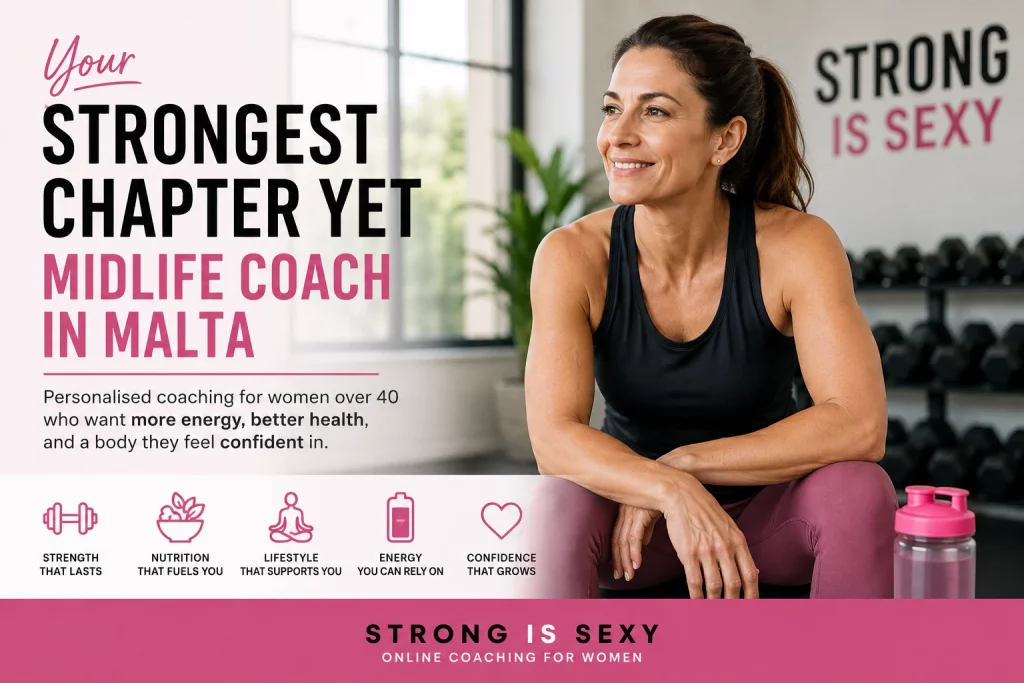
Midlife can feel like a completely different chapter of life.
For many women, the routines that once felt easy suddenly become harder to maintain. Energy may change, recovery can feel slower, work and family responsibilities become more demanding, and the fitness methods that worked in your twenties or thirties may no longer fit your lifestyle.
This is often the point when women begin searching for a midlife coach in Malta.
The goal of midlife coaching is not to make you believe that your body has suddenly stopped working because you have reached a certain age. It is about helping you understand what your body and lifestyle need now.
Your training may need more structure. Your nutrition may need to become more realistic. Your recovery may need more attention. Your goals may also shift from simply trying to lose weight to wanting to feel stronger, healthier, more energetic and more confident.
That change in focus can be powerful.
Midlife does not have to be a period where you accept feeling weaker, more tired or disconnected from your body. It can become the stage where you finally start training and eating in a way that supports your long-term health instead of chasing short-term results.
At Strong Is Sexy, the approach to coaching brings together personalised training, nutrition, lifestyle habits and support for women navigating their forties, fifties and beyond. The aim is not perfection. The aim is to create a routine you can actually live with.
What Does a Midlife Coach Actually Help With?
A midlife coach looks at more than one part of your health.
You may be exercising regularly but still struggling with your energy.
You may understand nutrition but find it difficult to stay consistent when work becomes stressful.
You may know you should strength train, but you are unsure what exercises are right for you or how hard you should be training.
This is where a broader coaching approach can help.
A midlife coach may support you with strength training, nutrition habits, daily movement, recovery, sleep routines, stress management, confidence, accountability, body-composition goals, and menopause-related changes where relevant.
The important point is that these areas are connected.
Poor sleep can make training feel harder.
Stress can affect food choices.
An unrealistic workout schedule can make consistency almost impossible.
Eating too little can leave you with less energy to train.
A good coaching plan considers the full picture instead of treating each problem separately.
Why Your Approach to Health May Need to Change in Midlife
Getting older does not mean your body stops responding to exercise.
However, your life may look very different from how it looked ten or twenty years ago.
You may have a demanding career, family responsibilities, less predictable sleep, and more stress. You may also be entering perimenopause, moving through menopause, or already be postmenopausal.
All of these factors can affect how easy it feels to stay consistent.
The solution is not always to do more.
Sometimes the smarter choice is to train more efficiently.
Instead of trying to fit five or six workouts into a busy week, you may progress better with two or three well-planned strength sessions that you can complete consistently.
Instead of following another restrictive diet, you may benefit more from improving protein intake, meal structure and everyday food choices.
Instead of treating recovery as something optional, you may need to see sleep and rest as part of the programme.
This is what makes midlife coaching different from simply following another fitness challenge.
Midlife Coaching Is Not the Same as Menopause Coaching
Midlife and menopause are closely connected, but they are not the same thing.
A woman can benefit from midlife coaching whether she is approaching menopause, already postmenopausal or simply reaching a point where her health and fitness priorities have changed.
Midlife coaching has a broader focus.
It looks at your strength, nutrition, confidence, lifestyle, recovery, long-term health habits and body composition.
Menopause coaching is more specific.
It focuses more directly on the changes women may experience during perimenopause, menopause and postmenopause.
If hormonal changes, symptoms or menopause-specific challenges are one of your main concerns, our guide to working with a menopause coach in Malta explores that topic in greater detail.
The important thing is to understand that midlife is bigger than menopause.
Your goal may simply be to feel stronger, move better, improve your energy and create healthier habits that will support you for the next decade and beyond.
Why Strength Becomes So Important in Midlife
For years, many women have been taught to think of exercise mainly as a way to burn calories.
Midlife can be an opportunity to change that mindset.
Instead of asking how many calories you burned, you can start asking what your body is becoming capable of doing.
Can you lift heavier than you could a few months ago?
Do stairs feel easier?
Can you carry groceries without struggling?
Do you feel more confident using weights in the gym?
Can you perform movements with more control?
These are meaningful signs of progress.
Strength training can help you maintain and build muscle, improve movement quality, support everyday function, and increase confidence.
You do not need to train like an athlete or compete in a strength sport.
You simply need a programme that matches your current ability and progresses gradually over time.
If strength is one of your main goals, our guide to women’s strength training in Malta explains the fundamentals in more detail.
The key idea is simple.
Exercise should support your life. Your life should not have to revolve around exercise.
Midlife Fitness Should Fit Around Your Real Life
One of the biggest mistakes women make is creating a fitness plan based on their ideal week instead of their normal week.
An ideal week might include five gym sessions, perfectly prepared meals and eight hours of sleep every night.
A normal week may include deadlines, family responsibilities, travel, stress and unexpected changes.
A good programme needs to work during the normal week.
For one woman, three gym sessions may be realistic.
For another, two strength sessions and regular walking may be a much better starting point.
The right plan depends on your schedule, your recovery, your experience and your goals.
That is why personalised coaching matters.
Instead of trying to force yourself into a programme that was designed for someone else, the programme is built around you.
This makes it easier to stay consistent and reduces the feeling that you have failed every time life becomes busy.
Nutrition in Midlife Should Feel Sustainable
Many women reach their forties having already tried multiple diets.
Low carbohydrate plans, low fat diets, detoxes, meal replacements, very low calorie diets and strict meal plans can all create short-term results.
The problem is that many of these approaches are difficult to maintain.
Midlife is often a good time to move away from extreme dieting and build a more realistic relationship with food.
That might mean eating more consistently throughout the day, prioritising protein, building balanced meals, increasing fruit and vegetable intake and learning how to manage busy days without giving up completely.
It may also mean learning how to enjoy meals out, weekends and social occasions without feeling that you have ruined your progress.
You do not need perfect nutrition.
You need nutrition that is consistent enough to support your goals.
If nutrition is currently your biggest challenge, our guide to working with a nutrition coach for women in Malta goes deeper into this area.
The goal is to create habits that feel normal, not temporary.
Midlife Weight Gain Needs a Bigger Picture Approach
Weight gain is one of the most common reasons women begin looking for support in midlife.
It can be frustrating when the strategies that previously worked no longer seem to create the same results.
The natural reaction is often to eat less.
But simply reducing food further is not always the best answer.
A better approach is to look at everything that may be influencing your progress.
Your nutrition matters.
Your training matters.
Daily activity matters.
Sleep matters.
Stress matters.
Weekend habits matter.
Consistency matters.
Hormonal changes may also play a role for some women.
This is why personalised coaching can be so useful.
Instead of reacting emotionally to the number on the scale, you can look at your actual habits and make targeted changes.
If fat loss is your main priority, our detailed Fat Loss Coach in Malta guide explores that goal more specifically.
The midlife approach is broader.
It focuses on creating a lifestyle that supports better health, stronger habits and sustainable body-composition progress.
Recovery Is Not Optional
Training is only one part of the process.
The time between your workouts matters too.
If your sessions constantly leave you exhausted, extremely sore and struggling to function normally, the programme may be too aggressive.
You should feel challenged by your training, but you should also be able to recover.
Recovery includes sleep, rest days, hydration, nutrition, stress management and appropriate training volume.
It may also mean making adjustments during busy weeks instead of abandoning the programme completely.
A strong coaching relationship gives you permission to adapt without feeling that you have failed.
For example, if your sleep has been poor and your stress is unusually high, reducing training intensity for a few days may be more productive than forcing yourself through a demanding session.
Long-term progress depends on balance.
Confidence Is a Real Midlife Goal
Not every important result can be measured on the scale.
For many women, the real goal is to feel comfortable in their body again.
You may want to feel confident entering a gym.
You may want to stop avoiding certain clothes.
You may want to feel physically capable.
You may simply want to prove to yourself that starting again at 45, 50 or 60 is still possible.
These goals matter.
Becoming stronger can change the way you think about your body.
Instead of constantly asking how much weight you can lose, you begin noticing what your body can do.
You begin seeing progress in your strength, movement, confidence, and consistency.
If you want to see how other women have progressed through structured coaching, you can explore the Strong Is Sexy transformation stories.
Real progress is often about much more than appearance.
Midlife Coach vs Personal Trainer
A personal trainer and a midlife coach can offer some similar support, but the overall focus may be different.
A personal trainer may primarily focus on your exercise sessions.
A midlife coach may look at your training, nutrition, recovery, behaviour, confidence and lifestyle together.
This can be especially useful if exercise is not your only challenge.
You may already know how to train but struggle to stay consistent.
You may train regularly but find that nutrition becomes difficult during stressful periods.
You may be working hard but not recovering properly.
You may also be experiencing changes related to perimenopause or menopause.
In these situations, simply changing your workout may not be enough.
If you want more information about general personal training options, our guide to finding a personal trainer for women in Malta covers that subject separately.
Who Can Benefit From Midlife Coaching?
Midlife coaching can support women in many different situations.
You may be entering your forties and deciding that your health needs to become a bigger priority.
You may be returning to exercise after several years away.
You may feel like your previous routine no longer fits your life.
You may want to become stronger.
You may want to improve your nutrition without starting another strict diet.
You may be navigating perimenopause or menopause.
You may simply be busy and need a flexible plan that works around your responsibilities.
The common theme is that you want something more personalised than a generic fitness programme.
You want a plan that reflects your current stage of life.
Online Midlife Coaching Across Malta
Working with a coach does not always require meeting in the same gym.
Online coaching can be particularly useful for women who want flexibility.
Whether you live in Valletta, Sliema, St Julian’s, Mosta, Mellieħa, Marsaskala, Gozo or elsewhere in Malta, online coaching allows you to follow a personalised programme from your preferred gym or training environment.
Through personalised online coaching for women over 40, you can receive structured training, nutrition guidance, progress tracking, regular check-ins and ongoing adjustments.
This gives you the freedom to train independently while still having professional support.
Your coach can review your progress and adapt your programme when your schedule, recovery or goals change.
For many women, this combination of flexibility and accountability makes online coaching easier to maintain than a rigid in-person schedule.
How to Choose the Right Midlife Coach in Malta
Choosing a coach should involve more than looking at transformation photos.
You need to understand how the coach actually works.
Look for someone who has experience supporting women in midlife and understands that your priorities may be different from those of a younger athlete.
Ask whether the programme is genuinely personalised.
Find out how training and nutrition are managed.
Check how often progress is reviewed.
Ask how the coach adapts your programme when your energy, recovery or schedule changes.
It is also useful to work with someone who understands perimenopause and menopause, even if these are not currently your main concerns.
Communication matters too.
You should feel comfortable asking questions and explaining when something does not feel right.
Most importantly, look for a sustainable coaching philosophy.
Be cautious of extreme restriction, punishing exercise, and unrealistic promises.
The best programme is the one that helps you improve without forcing you to temporarily stop living your normal life.
Questions to Ask Before Starting Midlife Coaching
Before you choose a coach, it can help to ask a few important questions.
Ask who they normally work with and whether they have experience coaching women over 40.
Ask how your programme will be personalised.
Ask whether they support both training and nutrition.
Find out how often your progress will be reviewed.
Ask how they adjust training when your recovery or energy changes.
Find out whether the programme can work around travel and busy weeks.
Ask what happens if you are completely new to strength training.
If menopause is relevant to you, ask about their experience supporting women through that stage of life.
You should also understand what kind of support is available between check-ins.
These questions help you understand whether you are receiving a personalised coaching service or simply being given another template.
What Does Progress in Midlife Really Look Like?
Progress can look very different from what you may have expected in the past.
You may notice that your clothes fit better.
You may become stronger.
You may feel more energetic.
You may start sleeping better.
You may stop avoiding the gym.
Your eating habits may become more consistent.
You may recover better from your workouts.
You may feel more confident in your body.
You may also notice that you are no longer restarting every Monday.
These changes are important.
They are often the behaviours that make long-term results possible.
If you want to see examples of women building strength, confidence and better habits through coaching, explore the Strong Is Sexy transformation stories.
Frequently Asked Questions About Midlife Coaching in Malta
What is a midlife coach?
A midlife coach helps women create a more structured approach to their strength, nutrition, lifestyle habits, recovery, confidence and overall wellbeing during their forties, fifties and beyond. The goal is usually to make fitness and healthy habits more sustainable while adapting them to the realities of midlife.
Is midlife coaching the same as menopause coaching?
No. Menopause coaching is more focused on perimenopause, menopause and postmenopause. Midlife coaching is broader. It can support women with training, nutrition, confidence, recovery, lifestyle habits and long-term health even when menopause is not the main concern.
What age is considered midlife?
There is no exact age that applies to everyone. In coaching, midlife often refers broadly to women in their forties and fifties, although some women may identify with the stage earlier or later depending on their circumstances.
Can a midlife coach help with weight loss?
A midlife coach can help you improve the habits that support body-composition goals, including nutrition, strength training, activity, sleep and consistency. If fat loss is your main objective, a more specialised fat-loss coaching approach may be useful.
Can I work with a midlife coach online from Malta?
Yes. Online coaching can provide personalised training, nutrition guidance, progress reviews and accountability without requiring you to meet your coach in person for every session.
Do I need gym experience?
No. A good coaching programme should begin at your current level. If you are a beginner, you can start with simple exercises and gradually progress as your strength, technique and confidence improve.
Is strength training important in midlife?
Strength training can be a valuable part of a balanced midlife fitness strategy. You do not need to lift extremely heavy weights. The focus should be on gradually becoming stronger using exercises that are suitable for your current ability.
Can midlife coaching help during menopause?
Yes. Midlife coaching can include support around training, nutrition and lifestyle during perimenopause and menopause. However, coaching should not replace medical care when symptoms require assessment or treatment from a qualified healthcare professional.
How often should I exercise in midlife?
There is no perfect number of sessions. Your training frequency should depend on your goals, experience, schedule, and ability to recover. A realistic plan you can follow consistently is usually more valuable than an ambitious plan you frequently miss.
Is it too late to start at 50 or 60?
No. You can start from your current level at any age. The most important thing is to choose an appropriate programme and build gradually.
Ready to Build a Stronger Midlife?
Finding the right midlife coach in Malta is not about finding someone who simply tells you to eat less and exercise more.
Most women already know that movement and nutrition are important.
The difficult part is knowing how to make everything work together.
Your training needs to fit your schedule.
Your nutrition needs to feel sustainable.
Your recovery needs to be taken seriously.
Your plan needs to adapt when life changes.
Midlife can be an opportunity to redefine what being healthy means to you.
Instead of constantly chasing a lower number on the scale, you can build strength.
Instead of restarting strict diets, you can create eating habits you trust.
Instead of depending on motivation, you can build structure.
And instead of seeing ageing as a reason to expect less from your body, you can start preparing yourself to feel stronger and more capable in the years ahead.
Strong Is Sexy offers personalised coaching for women over 40 that combines training, nutrition, lifestyle support and menopause-aware guidance.
If you are ready to stop guessing and start following a plan built around your real life, explore our online coaching programme for women over 40 and take the next step towards a stronger, healthier and more confident midlife.