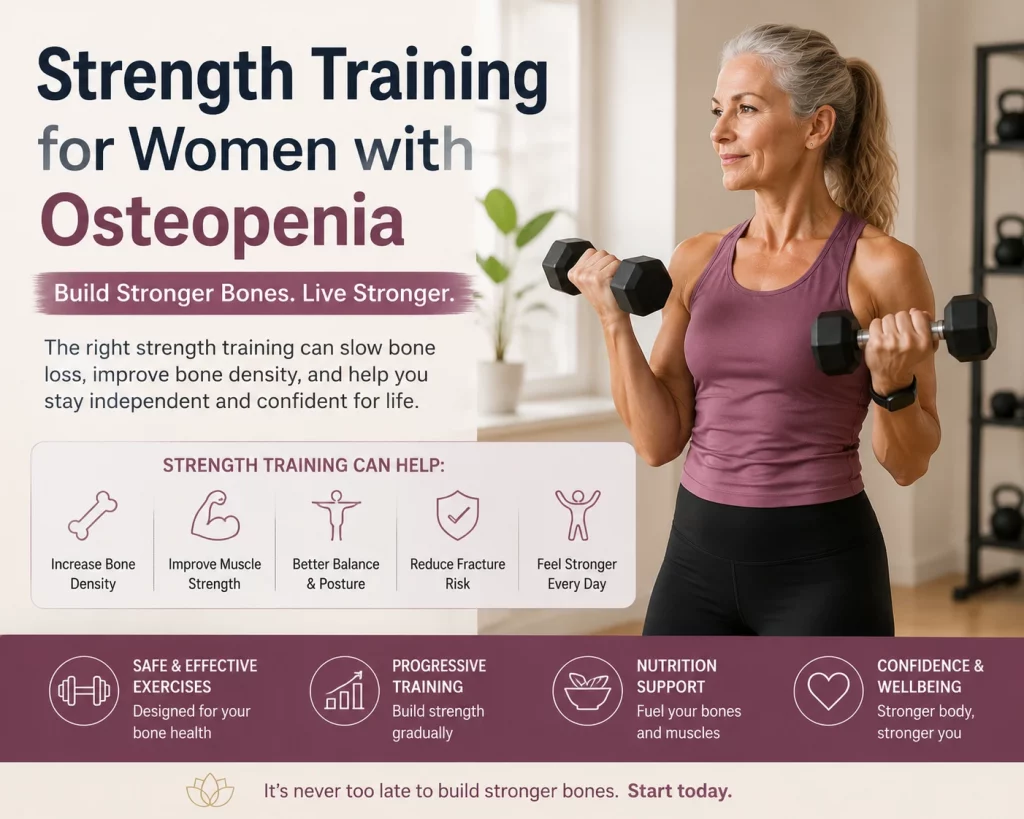
Hearing the word “osteopenia” for the first time can be unsettling. A bone density scan shows numbers lower than they should be, and suddenly you’re wondering whether it’s still safe to lift weights, go for a run, or carry your own shopping bags. Here’s the reassuring truth: strength training for women with osteopenia isn’t just safe; it’s one of the most effective tools you have to slow bone loss, rebuild density, and protect yourself from progressing to osteoporosis.
This guide walks you through exactly why resistance training matters for bone health, which exercises are most effective and safe, what to avoid, and how to structure a programme with confidence rather than fear.
What Is Osteopenia and Why Does It Matter?
Osteopenia means your bone mineral density (BMD) is lower than normal but not low enough to be classified as osteoporosis. It’s often picked up through a DEXA scan and is extremely common in women during and after perimenopause, largely due to the sharp drop in oestrogen, a hormone that plays a key role in maintaining bone-remodelling balance.
Left unmanaged, osteopenia can progress toward osteoporosis, which significantly raises fracture risk. But osteopenia is not a life sentence, and it’s not a reason to become more cautious with movement quite the opposite. Bone is living tissue that responds to mechanical stress, and the right kind of loading is one of the few things proven to actively rebuild it.
Osteopenia vs Osteoporosis: Understanding the Difference
It’s easy to assume osteopenia and osteoporosis are simply two names for the same thing, but they represent different points on the same scale, measured by a T-score from a DEXA (bone density) scan:
- Normal bone density: T-score of -1.0 or above
- Osteopenia: T-score between -1.0 and -2.5
- Osteoporosis: T-score of -2.5 or below
Osteopenia is essentially an early warning sign, a chance to intervene before bone loss progresses further. This is precisely why strength training is so valuable at this stage: it’s far easier to preserve and rebuild bone density when there’s still a solid foundation to work with, rather than trying to reverse more advanced bone loss later on. Many women are never told this clearly by their GP, and either panic unnecessarily or dismiss the diagnosis entirely; neither response is helpful. The most productive response is simple: start (or continue) progressive resistance training, and take nutrition seriously.
Why Strength Training Works for Bone Density
Bone follows a principle called Wolff’s Law: bone adapts to the loads placed on it. When you lift weights, push, pull, or carry load against gravity, you create mechanical stress on the skeleton. In response, bone-building cells called osteoblasts are stimulated to lay down new bone tissue, gradually increasing density over time.
This is different from most cardio. Activities like swimming or cycling are excellent for cardiovascular health but provide very little direct skeletal loading because the body’s weight is supported by water or a saddle. Weight-bearing and resistance-based movement where muscles pull directly on bone is what triggers the strongest osteogenic (bone-building) response.
Research consistently shows that structured resistance training, particularly using moderate-to-heavy loads, can:
Slow or halt further bone density loss
In many cases, increase bone mineral density at the hip and spine
Improve muscle strength, which reduces fall risk
Improve balance and coordination
Support joint stability and posture
Boost confidence in daily movement
Is Strength Training Safe for Osteopenia?
Yes, for the vast majority of women, strength training is not only safe but recommended by bone health specialists and physiotherapists. The key is progressive, well-programmed loading, not random or poorly executed lifting.
A few sensible precautions:
Get clearance from your GP or a specialist if you have osteopenia with additional risk factors, a history of fractures, or other health conditions.
Learn correct form before adding heavier load; technique matters more than the number on the bar.
Avoid movements involving excessive spinal flexion under load (e.g., rounding the back during a heavy deadlift or sit-up) if bone density in the spine is a specific concern, and work with a coach to select safer variations.
Progress gradually. Bone adapts over months, not days; patience and consistency outperform intensity spikes.
If you’re unsure where to start or nervous about doing the “wrong” exercise, working with a coach who understands hormonal and bone health changes can remove the guesswork. This is exactly the kind of programming built into hormone-aware strength and menopause support coaching, designed specifically for women navigating exactly this stage.
Best Types of Strength Training for Osteopenia
1. Weight-Bearing Resistance Exercises
These involve working against gravity while upright, directly loading the hips and spine — two of the most common sites for bone density loss.
Squats (bodyweight, goblet, or barbell)
Lunges and step-ups
Deadlifts (with appropriate form and progression)
Standing overhead press
2. Upper Body Loading
Wrist and forearm fractures are common with osteopenia, so upper body strength matters too.
Push-ups (or incline variations)
Rows (dumbbell, cable, or resistance band)
Chest press
Farmer’s carries (excellent for grip, core, and full-body bone loading)
3. Progressive Resistance Machines
Machines are a fantastic entry point for women new to strength training or rebuilding confidence after a diagnosis, as they control the movement path and reduce injury risk while still providing effective loading.
Leg press
Chest press machine
Seated row
Lat pulldown
4. Balance and Stability Work
While not “strength training” in the traditional sense, balance training reduces fall risk — and since falls are the leading cause of fractures in women with low bone density, this deserves a place in every programme.
Single-leg stands
Step-overs
Controlled tandem walking
Light stability ball or bosu work (once foundational strength is established)
How Often Should You Strength Train with Osteopenia?
Most bone health guidelines recommend:
| Training Component | Frequency |
| Resistance/strength training | 2–3 sessions per week |
| Weight-bearing cardio (walking, hiking, stair climbing) | 4–5 times per week |
| Balance training | 2–3 times per week (can be combined with strength sessions) |
| Rest/recovery days | At least 1–2 full rest days weekly |
Consistency matters far more than intensity in the early months. A well-structured programme performed twice a week reliably will outperform an aggressive programme abandoned after three weeks.
Sample Beginner-Friendly Weekly Structure
Monday: Full-body strength (squats, rows, standing press, farmer’s carries)
Tuesday: Brisk walk or light hike (weight-bearing cardio)
Wednesday: Full-body strength (deadlift variation, chest press, lunges)
Thursday: Rest or gentle mobility work
Friday: Full-body strength (leg press, lat pulldown, step-ups, balance drills)
Saturday: Weight-bearing cardio or active recovery walk
Sunday: Rest
This can be adjusted based on fitness level, and loads should increase gradually over weeks and months as strength and confidence build.
The Role of Nutrition Alongside Strength Training
Strength training builds the stimulus for stronger bone, but nutrition supplies the raw materials. Calcium and vitamin D are the most well-known bone nutrients, but protein is equally essential; bone tissue is roughly 50% protein by volume, and adequate intake supports both bone matrix formation and the muscle mass needed to protect your skeleton.
If you haven’t already, it’s worth reading how protein intake changes during menopause and why most women need considerably more than they think to support both muscle and bone health during this stage of life.
Other nutrients worth prioritising include:
Calcium – dairy, leafy greens, tinned fish with bones (like sardines), fortified plant milks
Vitamin D – sunlight exposure, oily fish, eggs, and supplementation (especially relevant in the UK given limited winter sunlight)
Magnesium and Vitamin K2 – nuts, seeds, leafy greens, fermented foods
Adequate overall calories – under-eating, especially alongside high training volume, can worsen bone density over time
Common Mistakes Women Make with Osteopenia and Exercise
- Avoiding strength training altogether out of fear – this often accelerates the very bone and muscle loss they’re trying to prevent.
- Only doing cardio, assuming “exercise” is enough without direct resistance loading.
- Starting too heavy, too fast – technique breakdown under excessive load is a real risk; gradual progression is safer and more effective long-term.
- Neglecting upper body and grip strength, despite wrist fractures being one of the most common osteopenia-related injuries.
- Ignoring balance training, which directly reduces fall risk – often the actual cause of a fracture, not the strength training itself.
- Under-eating protein and total calories while training, which can undermine both bone and muscle adaptation.
Working with a Coach Who Understands Bone Health
Not every personal trainer has experience programming safely and effectively around a bone density diagnosis. Working with someone who understands the interaction between hormonal changes, bone health, and progressive strength training removes the guesswork and builds genuine confidence in your body again. You can read more about how structured online coaching has helped women rebuild strength safely, and see real examples in the transformations section.
If you’d like a starting point before committing to coaching, the free guide is a useful first step, alongside more detail on nutrition support tailored to bone and muscle health.
How Is Osteopenia Diagnosed?
Osteopenia is diagnosed through a DEXA scan (dual-energy X-ray absorptiometry), a quick, low-radiation scan typically of the hip and spine. In the UK, this is usually arranged through your GP if you have risk factors such as:
- Family history of osteoporosis or fractures
- Early menopause (before age 45) or surgical menopause
- Long-term use of certain medications (e.g. corticosteroids)
- Low body weight or a history of disordered eating
- Smoking or high alcohol intake
- Certain autoimmune or hormonal conditions
Osteopenia itself often has no obvious symptoms, which is part of why routine bone density screening matters for women approaching or going through menopause, even in the absence of pain or visible signs.
Frequently Asked Questions
Can strength training reverse osteopenia?
In many cases, yes, consistent, progressive resistance training has been shown to increase bone mineral density at key sites like the hip and spine, particularly when combined with adequate protein, calcium, and vitamin D intake.
What exercises should be avoided with osteopenia?
High-impact, uncontrolled movements or exercises with poor spinal loading technique (such as heavily loaded spinal flexion) should be approached cautiously. This doesn’t mean avoiding strength training; it means learning correct form and progressing sensibly, ideally with guidance.
Is walking enough exercise for osteopenia?
Walking is a valuable weight-bearing activity and should be part of your routine, but it doesn’t provide enough mechanical loading on its own to significantly build bone density. Resistance training is the more powerful tool for that specific goal.
How long does it take to see improvements in bone density from strength training?
Bone remodelling is a slow process. Most research shows measurable improvements in bone density after 6–12 months of consistent, progressive strength training, though strength, balance and confidence often improve much sooner.
Do I need to lift heavy weights to improve bone density?
Progressive overload matters more than lifting maximally heavy from day one. Starting with manageable loads and gradually increasing weight over time provides the mechanical stimulus bone needs, without unnecessary injury risk.
Key Takeaways on Strength Training for Women with Osteopenia
An osteopenia diagnosis is a signal to move more deliberately, not less. Strength training done consistently, progressively and with good technique is one of the most effective, well-supported strategies for protecting and even rebuilding bone density, alongside supporting muscle mass, balance and everyday confidence. Paired with adequate protein and key micronutrients, it gives your body exactly what it needs to get stronger from the inside out.
If you want a personalised programme built specifically around your bone health, strength level and goals, hormone-aware coaching can help you train with confidence rather than fear.